

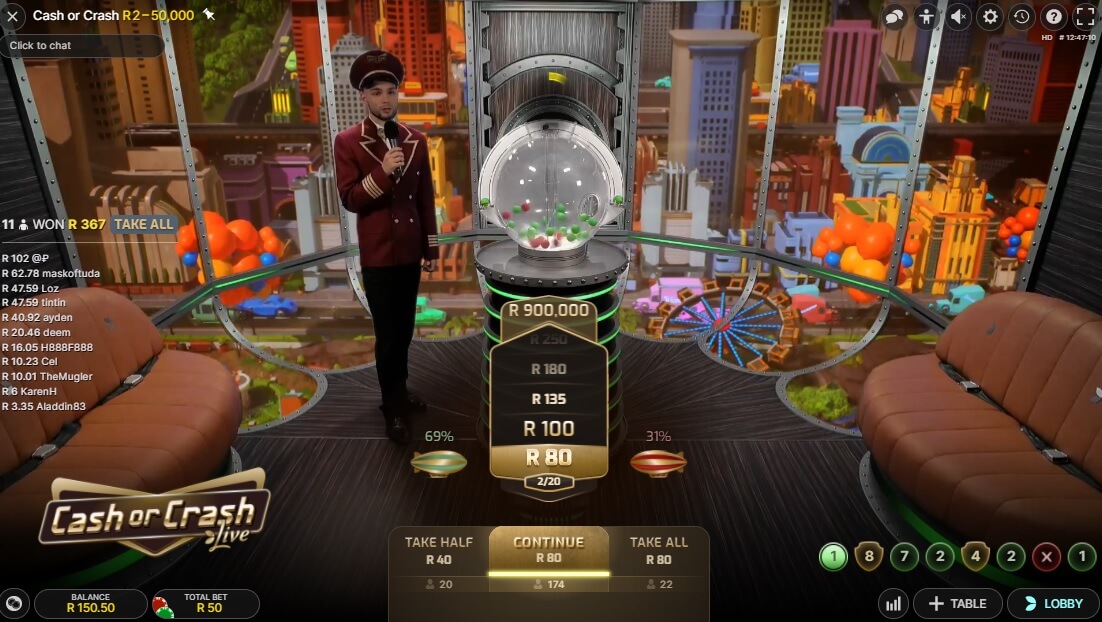
Cash or Crash Live carves out its own territory in the live game show world https://cashorcrashcasino.com/. Its magic is found in a powerful blend of studio spectacle and game design that transforms every round into a test of your nerves. This is no a mere spin of a wheel of chance. Here, you are in the pilot’s seat, making decisions that directly control what you win. The premise hooks you with a climbing multiplier, then challenges you to take it before a hidden “crash” clears the board. To get the most out of the game, you should see beyond the flashy show and grasp its real function. Let’s break down the phases, the host’s role, the math behind the risk, and how players can practically navigate the thrills.
The Core Objective and Core Mechanics
The aim of Cash or Crash Live is straightforward on the appearance. You have to decide when to cash out a increasing multiplier before a secret “crash tracxn.com point” terminates the game and claims your winnings for that stage. Every game begins with players making bets. A rocket then begins its flight, and a multiplier begins ticking up from 1x. The trip has several stages. Before launch, a unknown crash multiplier is determined for each stage, hidden from nobody. As the value rises, players individually decides to hit “Cash Out,” locking in that multiplier on their bet, or to remain. If the rocket triggers the unknown crash point ahead of a player exits, they forfeit their stake for that round. The loop of danger and gain repeats over several rounds. Surviving players grow their winnings incrementally.
Deconstructing the Stage Structure
Think of the game as a sequence of distinct segments, each a new risk. Surviving a crash doesn’t eliminate you. You proceed to the subsequent stage with your built-up winnings intact, then start the risk cycle from scratch on the following part of the rocket’s flight. This setup is critical. It creates a narrative, with pressure that mounts as you progress. The announcer heightens the tension, revealing how many players are still staying on the rocket as the multiplier reaches frightening values. Early stages often see conservative plays. Subsequent phases, with their high-stakes multipliers, lure you to gamble the winnings you’ve previously won. This division is the core of the game’s drama. It forces a string of independent, high-pressure decisions instead of a single one.
From Green to Red: The Risk Escalation
Notice the color-coded path the rocket travels. It’s a core part of the game’s vocabulary. The first part is usually a “Green Zone,” a lower-risk phase where a crash is still a possibility. Then, the rocket could reach an “Amber Zone,” a distinct indication that hazard is increasing. The final stretch is the “Red Zone.” Here, multipliers are their highest, but the chance of a crash is statistically at its highest. These colors are more than decoration. They offer a quick visual for the hazard level at any given time. They transform an theoretical probability seem concrete. Understanding the game is intentionally warning you about rising volatility is a key piece of game strategy.
The purpose of the on-air host and RNG

The live host does more than talk. They establish the game’s emotional pace. While they can’t affect the result, they skillfully build suspense. They shout out the climbing multiplier and offer live updates on what percentage of the crowd is cashing out at each level. That social cue can mess with your head. But remember, the host works separately from the game’s engine: the Random Number Generator (RNG). The crash point for each stage is set by a certified RNG the instant the stage begins. This assures fairness and total unpredictability. The host has no clue when the crash will happen. Their job is entertainment. The RNG’s job is certifiable fairness. This combination merges transparent live action with provably random results.
Theoretical Foundations and Variance
Let’s examine the figures that power the game. The multiplier for every round is based on a defined probability model. Frequent, small multipliers such as 1.2x or 1.5x are very likely to occur. Extremely high multipliers can occur, but they are exponentially more improbable. This model ensures the game fair. The regular, small crashes finance the occasional, large potential wins. The “Return to Player” (RTP) is a statistical percentage across millions of rounds. In a single gaming session, the variance are extreme. You’re not wagering against the house in a traditional way. You’re acting against a hidden, random number. Remember these points:
- Isolated Stages: Every round’s crash point is an independent occurrence. A 1.2x crash in the first stage does not predict the second.
- No Forecasting Ability: The RNG eliminates any predictable patterns. Previous crashes or large wins do not affect future rounds.
- House Edge: The system incorporates a house advantage, which is evident in the provider’s published RTP.
Tactical Approaches and User Behavior
No strategy can overcome the core randomness. But you can employ disciplined approaches to manage your funds and your feelings. The central dilemma is a compromise. Do you secure guaranteed profit, or aim for exponential growth? Users often employ methods like the “Fixed Cash-Out.” In this case, you determine ahead of time to withdraw at a certain multiplier, say 2x, in every phase. This aims for stable, small wins. The reverse is the “Let It Ride” approach, where you wager multiple stages for a opportunity for a monster payout, accepting that crashes will occur. A more measured tactic is the “Percentage Bankroll” method, where you change your wager amount based on your existing gains. The key aspect, though, is in your psychology. Can you resist the “greed factor” when the payout rises? Can you avoid annoyance after an initial failure? Your most powerful tool is creating firm guidelines for yourself before the session even launches.
Frequent Errors to Steer Clear Of
Look out for a few classic mistakes. The most destructive is “chasing” a loss. This means recklessly increasing your bet after a setback, which contradicts the game’s stage-independent structure. Another misstep is gov.uk falling for the “hot hand” illusion, assuming a run of big payouts is expected to continue. Letting the presenter’s banter or the behavior of other users distract you from your own predetermined strategy is widespread. Also, don’t misread the zones. The Amber and Red Zones aren’t challenges to overcome. They are signals that the risk has jumped. Going into any phase without a clear goal converts the activity from a process of judgment into a sheer emotional ride. That journey hardly ever concludes favorably.
Conclusion: A Harmony of Chance and Choice
Cash or Crash Live is a fascinating fusion of pure fortune and deliberate selection. Its workings are built to craft a tale of escalating risk, powered by a transparent RNG and brought to life by a charming emcee. Defining winning as a enjoyable and possibly profitable session depends on a few things. It’s not so much about predicting the uncertain and rather about understanding how the game is constructed. It calls for managing your money with discipline and managing the mental impulses the game masterfully triggers. By mastering its phases, understanding its numeric structure, and following a personal strategy, you can change your outlook. You go from bewildered uncertainty to knowledgeable involvement in a exceptionally intense live game show.